
Bosch Packaging Technoloy
Riding the waves
According to a recent survey conducted by German market intelligence organizations EHI and GS1 entitled‚ Trendstudie 2011: Verpackung und Produktschutz’ (2011 trend study: packaging and product protection), product safety is a key priority for both retailers and consumers when it comes to food packaging. Ultrasonic technology from Bosch Packaging Technoloy offers crucial benefits from a product safety perspective.
According to a recent survey conducted by German market intelligence organizations EHI and GS1 entitled‚ Trendstudie 2011: Verpackung und Produktschutz’ (2011 trend study: packaging and product protection), product safety is a key priority for both retailers and consumers when it comes to food packaging. Ultrasonic technology from Bosch Packaging Technoloy offers crucial benefits from a product safety perspective.
There is an increasing drive to save resources and reduce costs through more efficient production processes. Packaging systems with maximum overall equipment effectiveness (OEE) enable this optimal usage of resources. Ultrasonic sealing technology is one possibility that enables manufacturers to reduce both costs and product waste while providing strong product protection. Reduced energy consumption, material savings and increased equipment availability allow manufacturers to produce more sustainably and profitable. In comparison to other sealing methods used to date, such as hot and cold sealing, ultrasonic technology represents an attractive alternative.
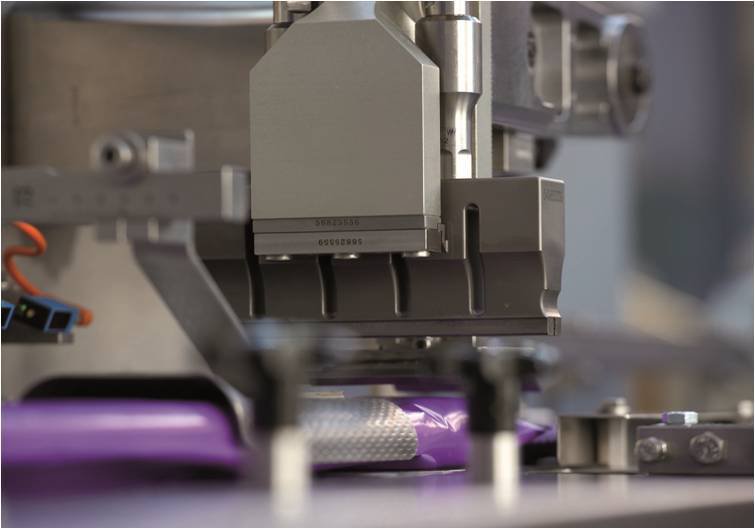
Ultrasonic technology offers crucial benefits from a product safety perspective. The new technology avoids the risk of diminished seam quality and leakage due to contamination of the sealing area by using high frequency vibrations that remove product residues. The resulting sealed seams are secure, ensuring the product is tightly packaged.
One drawback associated with the often-used hot sealing method is the negative influence on product quality by the required sealing heat. The high temperature of the sealing jaws can cause product damage: here ultrasonic’s “cold” approach is a major advantage. Since the tools used are cold, the sealed seam can be placed close to the product without having a negative impact on its quality.
Manufacturers can further benefit from the fact that there is no risk of heatrelated damage to materials or products in the event of machine stoppages. A popular alternative in the past, when packaging heat-sensitive products like chocolate, was to use cold sealing film to prevent products from melting.
One disadvantage of this approach is the limited storage life of the film, which tends to stick together or to the product. Furthermore, the relatively high costs involved with cold sealing film have encouraged manufacturers to consider alternative sealing methods like ultrasonic technology.
Ultrasonic sealing technology provides significant savings in terms of the energy required for the packaging process. The film is not heated from the outside inwards, but as a result of molecular vibration within the film. As such, the temperature needed for welding purposes is generated inside the film in the actual sealed seams. This means, for example, a horizontal flow wrapping machine requires only 4.0 joules for sealing compared to hot sealing with 6.7 joules.
As a further benefit, savings can be made with material costs. For horizontal packaging applications, manufacturers can use less expensive film materials, replacing the kinds of films previously required for hot sealing with thinner and more cost-effective alternatives. In addition, the narrower sealed seams possible with ultrasonic sealing technology reduce the amount of material needed. With vertical form, fill and seal machines, up to 16 millimeters of film can be saved per package in terms of bag length.
The “cold” ultrasonic sealing technology also eliminates the need to clean hot sealing jaws. By reducing the issue of film sticking to the heated jaws, ultrasonic technology ensures that there is less material residue after sealing and fewer defective packages, all of which can help to reduce equipment downtime. As a result, manufacturers can see significantly increased operating times and a reduction in waste material.
Ultrasonic sealing technology from Bosch Packaging Technology is currently available for long- and cross-sealing stations on its horizontal flow wrapping and vertical form, fill and seal machines. Examples of horizontal flow wrappers for ultrasonic sealing are the Sigpack HCUR, the Sigpack HCUL and the Miniwrap BVK 2000 UA, which use, respectively, rotary and long dwell cross-sealing stations. Bosch also offers vertical form, fill and seal machines incorporating ultrasonic sealing technology. Two examples are the SVE 3615 LR with cross and long sealing and the SVE 2520 AR using ultrasonic technology for cross sealing. The typical pack styles produced on these types of equipment are block-bottom, pillow, gusseted and doy-style bags. With horizontal bag types, ultrasonic can be used for both single packs and multipacks.
Not only can ultrasonic technology be used as a sealing method, but also for processing confectionery. The technology is ideally suitable for difficult cutting applications such as sensitive, sticky, laminated or layered products like bars, cakes and pet food. It is used to cut across strands of product, dividing them into individual sections or segments. The use of high-frequency vibrations enables clean cuts and produces smooth surfaces. Product quality remains high due to the low levels of tension and pressure applied. One current ultrasonic cutting application from the Bosch portfolio is the WRQ 0400 US ultrasonic cross-cutter for bar production.
With its innovative technology, Bosch Packaging Technology supports improving the current situation in terms of resource saving. Ultrasonic sealing is a key part in this initiative and Bosch is continuing to develop this technology to expand the range of possible applications. Ultrasonic technology is more than a contribution to an environmentally friendly and profitable production. It will also play an important role in the future for process safety, since ultrasonic sealing can be used to validate the packaging process. Given the increasingly stringent regulations imposed on the food industry, this may become an important consideration for food manufacturers as well.
By Prof Dr Bernd Wilke, Head of Research and Development, Bosch Packaging Technology